Tel:15324226647 Mob:+86-13930552202 Skype:Lengstech Whatsapp: +86-13930552202


The sintering process of SOFC single cells, electrolyte sheets, electrode layers and interconnects involves extremely harsh working conditions: long-term high temperatures ranging from 600℃ to 1450℃, alternating oxidizing and reducing atmospheres, as well as repeated rapid heating and cooling cycles. Meanwhile, battery sheets impose strict requirements on plate flatness, uniform support and zero impurity contamination.Conventional kiln furniture made of cordierite, alumina and reaction-bonded silicon carbide are prone to high-temperature creep and warpage, powder shedding and impurity infiltration. These defects easily cause delamination, cracking and inconsistent performance of sintered cells, leading to high rejection rates.
Fabricated via binder-free recrystallization sintering above 2100℃, RSiC recrystallized silicon carbide features interlocked pure SiC grains without glass phases or free silicon. It resists high-temperature creep and impurity precipitation while delivering uniform thermal distribution. As premium high-temperature carrier plates for sintering SOFC electrolytes, green anode/cathode substrates and stacked cell components, RSiC setters perfectly match all high-temperature firing curves in SOFC production.
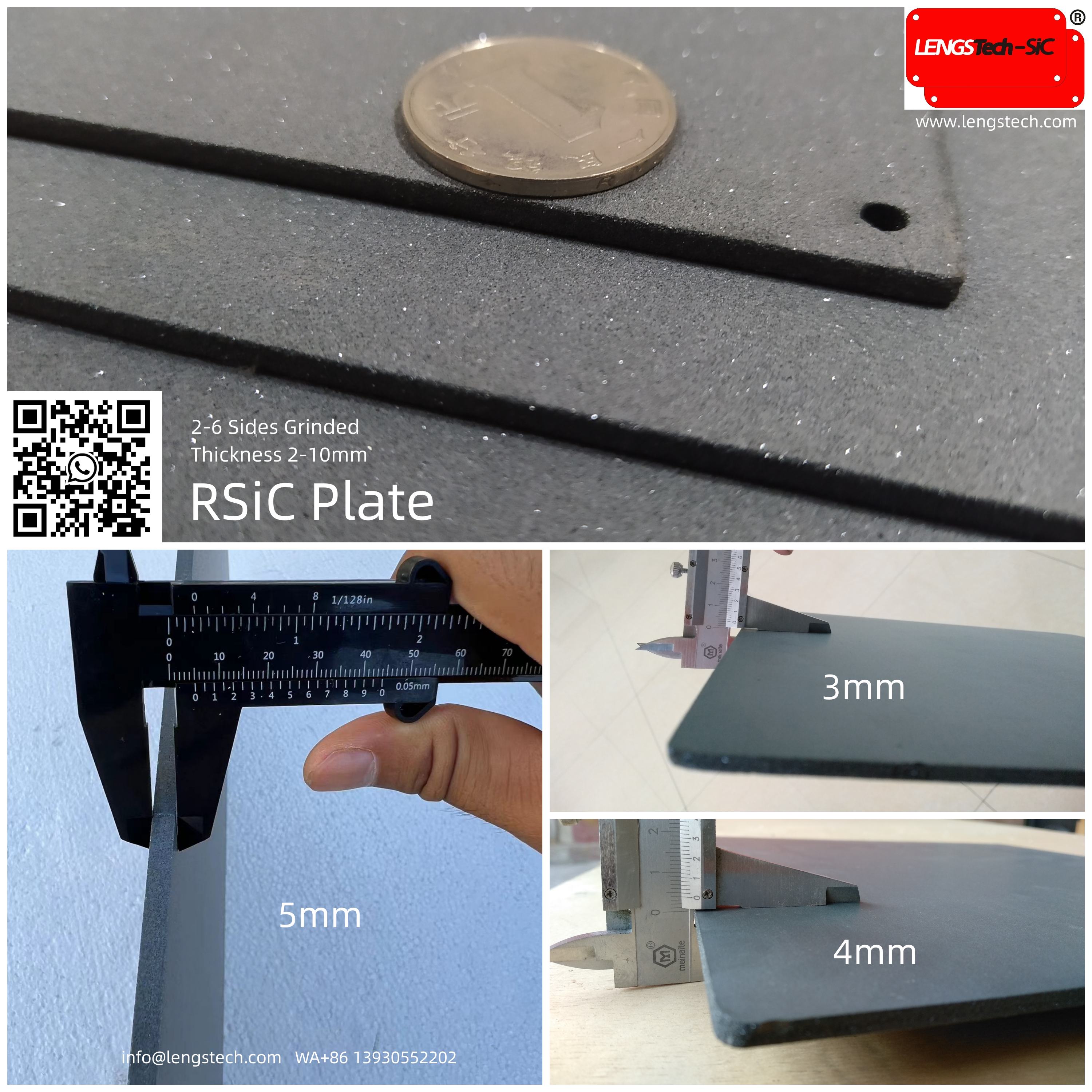
Ultra-thin SOFC ceramic substrates are susceptible to deformation under uneven stress. All our plates adopt diamond precision grinding to control geometric tolerances strictly, eliminating stress points that cause warpage and uneven thickness of finished cells.
Fully Customizable DimensionsWe provide custom square, rectangular, boss-positioned, slotted and hollow breathable structures. Plate thickness ranges from 2mm to 10mm with unlimited length and width specifications. Our products fit lab-scale trial furnaces, mass-production pusher kilns and roller kilns. Matching RSiC supports and crucibles are also available as complete sets.
Ultra-Flat Polished SurfacesDouble-sided precision diamond grinding is applied to each plate. The overall flatness is controlled below 0.5mm, ensuring no suspended areas on laid thin SOFC sheets and consistent shrinkage during sintering.
Minimal Permanent Bending DeformationBenefiting from low thermal expansion raw materials and precision flattening treatment, the room-temperature bending degree is limited within 60μm. The plates maintain stable deformation indicators after hundreds of thermal cycles without arching or sagging, reducing frequent plate replacement and furnace downtime.
Tight Dimensional Tolerance ControlLength, width and thickness tolerances are uniformly controlled within ±0.3mm. Consistent batch dimensions enable smooth stacking inside kilns and automated loading/unloading, fully compatible with automated mass-production lines for SOFCs.
Zero High-Temperature Creep, Stable Shape After Long-Term CyclesFree of low-melting binding phases, RSiC plates show no softening or sagging under long-term load at 1600℃, outperforming ordinary SiC boards with severe high-temperature creep. With an ultra-low thermal expansion coefficient, the flatness and bending indicators remain stable after dozens or hundreds of rapid thermal cycles. The service life reaches over 6 times that of traditional kiln furniture, cutting costs caused by frequent replacements and production halts.
High Thermal Conductivity for Homogeneous Temperature & Consistent SOFC Electrochemical PerformanceSuperior thermal conductivity compared to alumina and cordierite minimizes temperature gradients across the plate surface. Electrolytes and electrode layers receive even heating to avoid over-sintering or under-sintering, which otherwise trigger high internal resistance, reduced cell power output and inconsistent batch performance. Stable power generation efficiency of finished SOFCs is guaranteed.
High Purity & Contamination-Free, Preventing SOFC FailureThe silicon carbide purity exceeds 99%, containing no free metals or low-melting silicates. No ions precipitate or powder sheds at high temperatures, and no solid-phase reactions occur with YSZ electrolytes or perovskite electrodes. The plates avoid impurity-induced rising interfacial resistance and accelerated cell degradation, meeting strict clean sintering standards for high-end fuel cells.
Excellent Thermal Shock Resistance for Fast SOFC Sintering CyclesThe unique interlocking grain porous structure buffers thermal stress, enabling the plates to withstand rapid heating and quenching without cracking or edge chipping. They adapt to energy-saving short-cycle sintering processes for SOFCs, shortening production tact time and lowering energy consumption.
Resistance to Oxidizing & Reducing Atmosphere CorrosionStable under alternating air oxidation and hydrogen reduction environments during SOFC sintering, the plates resist erosion from alkali metals and volatile powder compounds. Electrode powder barely adheres to surfaces for easy cleaning, avoiding cross-contamination between production batches.
Lightweight & High Mechanical Strength to Boost Furnace Loading CapacityUnder equal load-bearing requirements, thinner plates reduce self-weight and heat storage inside kilns, speeding up temperature rise and cutting energy costs. High flexural strength allows multi-layer stacking to raise single-furnace SOFC output, ideal for large-scale industrial mass production.
Green body pre-sintering and final firing of YSZ, GDC solid electrolyte thin sheets
Co-firing processes for NiO-YSZ anodes and LSCF/LSM perovskite cathodes
High-temperature heat treatment of SOFC cermet interconnects and sealing components
Lab bench-top box furnaces, pilot roller kilns and large-scale mass-production pusher kilns with full sets of sintering tooling
For the industrialization of clean energy SOFCs, high-precision RSiC recrystallized silicon carbide setter plates feature fully customizable sizes, ultra-flat surfaces (flatness ≤0.5mm), bending degree ≤60μm and tight dimensional tolerance ≤±0.3mm. Combined with superior material properties including high-temperature creep resistance, contamination-free high purity, uniform heat distribution, energy efficiency and long service life, our setter plates solve core pain points in fuel cell sintering such as substrate deformation, inconsistent performance and impurity pollution. They serve as irreplaceable high-precision high-temperature carrier kiln furniture for solid oxide fuel cell manufacturing.

Tel:15324226647
Mobile:+86-13930552202
E-mail: info@lengstech.com
Skype: Lengstech
Whatsapp: +86-13930552202


Copyright 2026 © Tangshan LENGS Technology Co., Ltd. All Rights Reserved.


